
Iberia Parish Parole and Probation
Louisiana DPS&C Division of Probation and Parole supervises both groups in the Iberia Parish region, but the legal paths are not interchangeable. Probation is a sentence or condition imposed by a court. It may follow a jail term, or the court may order it without a prison release. Parole is a conditional release from imprisonment under the law that applies to the offense and sentence. Good-time release, also called diminution of sentence, can place a person under supervision without a discretionary parole-board grant.
The source record should settle the label. An Iberia Parish court minute can show probation. A Committee on Parole result can show whether parole was granted, denied, deferred, or reconsidered. Louisiana DPS&C or LAVNS may then show a later custody change. None of those records, alone, proves that every condition has ended. Full discharge means the applicable custody and supervision term is complete.
| Feature | Parole | Probation |
|---|---|---|
| Legal source | Conditional release from imprisonment under applicable parole law | Sentence or condition imposed by a court |
| Best first record | Parole docket, result, and later DPS&C custody status | 16th Judicial District court minute |
| Local contact | New Iberia District Office | New Iberia District Office when that office supervises the case |
| End point | Formal discharge after supervision ends | Court or agency completion and discharge record |
- Discharge
- The formal end of the relevant custody or supervision term.
- Absconder
- A person alleged to have stopped reporting or otherwise left supervision without authority.
- Revocation
- A process that may withdraw conditional release after an alleged violation and a hearing.
- Diminution
- A lawful reduction in time based on Louisiana sentence-credit rules.
Verify Iberia Parish Post-Release Supervision
Begin with identity and legal authority. Iberia Parish Criminal Justice Facility houses local, state, federal, and other-agency prisoners. A name leaving its current roster can reflect community release, a transfer, or another custodian taking control. The Iberia Parish released-inmate search and record path explains how to obtain the actual release code and destination before assigning a supervision label.
- Confirm the release basis. Read the jail release code, court minute, parole result, or Louisiana DPS&C record. Do not turn a missing roster entry into proof of parole.
- Match the person. Use the name, date of birth, booking identifier, or DPS&C number available in the source record. Similar names require separate identity checks.
- Use the correct public channel. Search Louisiana VINE/LAVNS for custody wording and check the 16th Judicial District record for probation or a court order.
- Check parole documents when relevant. Find the hearing docket and later result. A scheduled hearing is not a grant, and a grant is not the physical release time.
- Confirm the district. Contact the New Iberia District Office for the correct process and office. Staff may not disclose protected case-management details.
- Separate supervision from discharge. An active, absconder, warrant, revocation, or community-supervision status is not a completed discharge.
Note: No official Iberia-specific public absconder database was located, so use the supervising office and court or warrant source.
Iberia Parish Supervision Office Region
The New Iberia District Office serves Iberia, St. Martin, and St. Mary Parishes. This three-parish jurisdiction is the distinctive local layer for Iberia Parish post-release supervision. A person released in Iberia may therefore report to a regional office rather than a parish-only unit. The office identifies Chad Breaux as district manager and publishes its contact hours.
New Iberia Probation and Parole
1221 Adrian Street
New Iberia, LA 70560
Phone: 337-373-0014
Fax: 337-373-0109
Monday through Friday, 8:00 a.m. to 4:30 p.m.
The office reports a workload of 3,200 cases: 1,950 probation and 1,250 parole or good-time parole cases. Its page separately discusses specialized violent-offender and sex-offender caseloads. Those specialized categories may overlap the totals and should not be added as distinct people. The figures show the scale of the regional operation, not a live count of released Iberia Parish residents.
The official office directory below provides both the regional scope and the published workload. It is the best visual reference for confirming which DPS&C office serves Iberia Parish supervision cases.
View the official New Iberia District Office listing before relying on contact details.
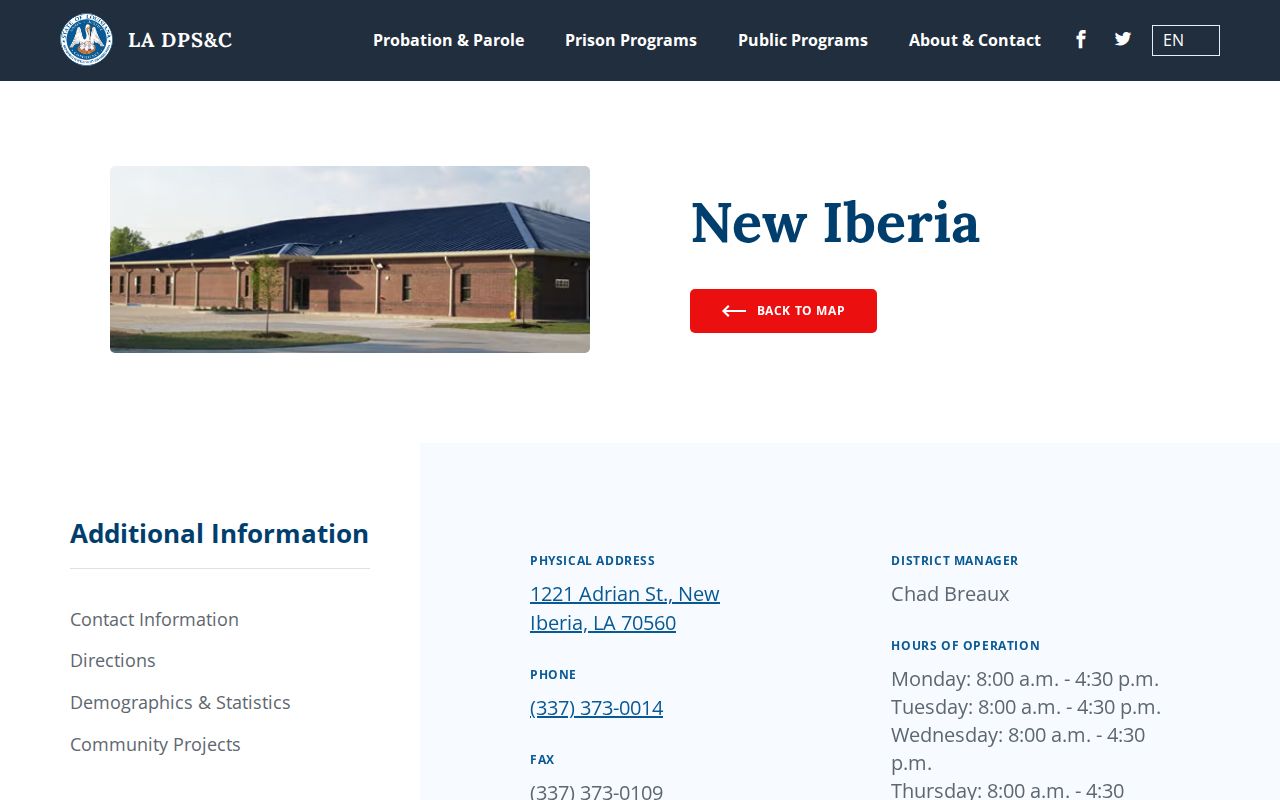
The listing ties Iberia Parish parole and probation questions to a regional state office and documents its public contact route.
Iberia Parish Parole Hearing Records
The Louisiana Committee on Parole is the decision body within the Board of Pardons and Committee on Parole structure. Its Parole Dockets page posts hearing notices, agendas, dockets, and linked results by date. Search a linked file by surname and DPS&C number. Then confirm the hearing date, session, institution or location, and hearing type.
Return after the proceeding for the matching result. Published actions may include granted, denied, deferred, rescinded, or reconsidered. A grant can authorize parole subject to legal and administrative steps, but it does not establish when a person walked out of custody. Denial or deferral means the application did not produce release. Rescission can undo a prior grant before release.
The official docket archive reaches back to 2012 and uses multi-day Hearing Week notices. It is more accurate to say hearings recur throughout the year than to promise one meeting each month. Review the current parole calendar and results route shown here.
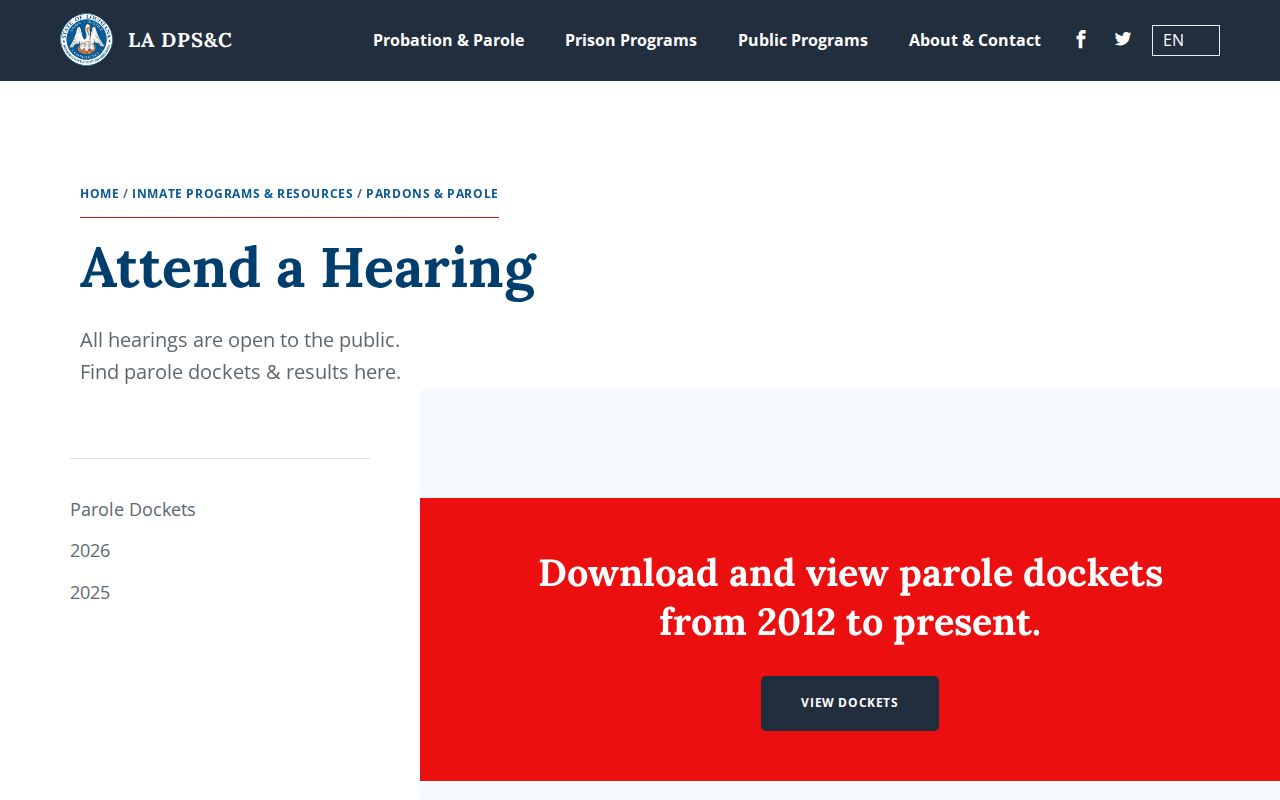
The docket image shows why the hearing date and final action must be tracked separately from the later physical-release date.
Note: Record offense, sentencing, eligibility, hearing, decision, physical-release, and discharge dates separately because each marks a different event.
Iberia Parish Revocation and Absconders
A claimed violation does not itself prove that Iberia Parish supervision ended or that the person returned to jail. Conditions can address reporting, travel, treatment, financial duties, or other terms set by law and the supervising authority. An absconder label generally indicates that supervision remains active while enforcement is sought. A warrant can exist without a new Iberia Parish booking.
Louisiana publishes separate revocation schedules and dockets. The page says hearings begin at 8:30 a.m., docket pages are updated at noon on weekdays, and schedules remain subject to change. A preliminary hearing follows execution of a parole warrant. A revocation hearing may lead to an oral and written decision with reasons. Questions about those dockets go to 225-342-6622.
Use the revocation document for the proceeding and outcome. Use LAVNS, the jail record, or the receiving agency to confirm actual custody. A docket entry alone does not prove the person is housed at Iberia Parish Criminal Justice Facility. Likewise, a person absent from the local roster may be in another parish or in Louisiana DPS&C custody.
A preliminary hearing and a final revocation hearing also serve different roles. The first follows execution of a parole warrant under the process described by DPS&C. The later hearing can result in a reasoned decision. Keep the warrant date, custody date, hearing date, and decision date apart. That record sequence prevents an Iberia Parish supervision problem from being mislabeled as a new conviction or a completed discharge.
Iberia Parish Reentry Referral Network
The New Iberia District Office documents local referrals and program partners for people under supervision. Named resources include Keys for Sober Living, Iberia Homeless Shelter, Lafayette Psychology Center, and Aten Counseling Center. These are navigation points listed by the state office. They are not proof that a person is enrolled, eligible, or in compliance with supervision.
A useful request is narrow: ask the supervising officer or district office which approved referral channel applies to the person’s current plan. Program participation and case-management facts may be protected. The official office page is the source for the names and should be checked for current information before contact.
This local network matters because post-release supervision is more than a custody label. A court or agency may require treatment, reporting, or other structured steps. The New Iberia office is the correct starting point for confirming official instructions, while each provider controls its own intake and service rules.
Note: A listed referral partner does not prove that any named person receives services or satisfies a supervision condition.
Iberia Parish Supervision Discharge
Physical release, community supervision, and discharge occur at different points. A person may leave prison on parole or good-time supervision and remain under Louisiana corrections authority. Probation may continue after a local jail term ends. Only the record from the court or supervising authority can establish that the term was completed or formally discharged.
When status is unclear, compare the Iberia Parish court minute, Committee on Parole result, Louisiana DPS&C or LAVNS wording, and any discharge document. Ask for the exact effective date. Do not infer completion from the person being outside a facility. A conviction and court record may also remain after supervision ends unless access is later limited by a lawful sealing or expungement order.
Louisiana law changed significantly for offenses committed on or after August 1, 2024. Ordinary parole was largely removed for new offenses, subject to statutory and constitutional exceptions. Older matters remain tied to the law in effect for the offense and sentence. The offense date must be known before a parole path or discharge sequence is described.
When requesting proof, ask for the narrow record that answers the question. A court minute can establish a probation order. A parole result can establish committee action. A supervising authority can confirm the proper route for an active or discharged status. Louisiana corrections records also have statutory confidentiality limits, so a public inquiry should not demand protected case notes or the complete corrections file.